
Our wind power innovations
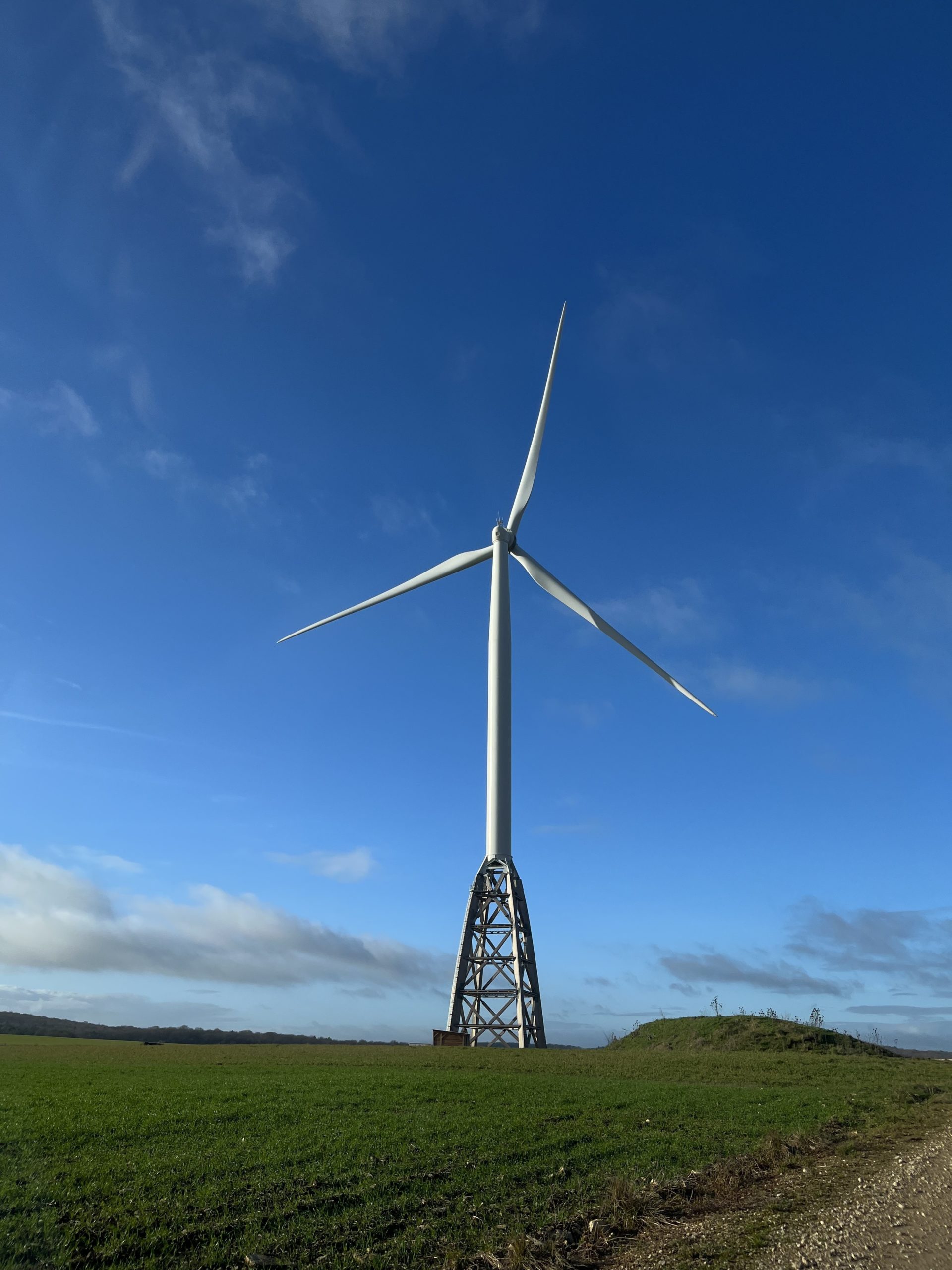
The hybrid wood/steel mast
This innovation arose from an observation: wind turbines require very large quantities of steel. In 2013, Grégoire Verhaeghe, President of InnoVent, visited Timbertower in Germany, which had just installed the world’s first wooden wind turbine. In 2014, while the process of obtaining a building permit for the Essey-les-Ponts wind farm was proving difficult, we proposed the solution of wooden masts, an alternative that appealed to the prefect, who wanted to create the first national forest park in Haute-Marne.
In 2017, just after obtaining the building permit, we realised that the all-wood mast, which was still a prototype, was not necessarily ideal. So in 2018, we proposed a hybrid wood/steel mast model.
These masts offer numerous advantages:
– Local road repair works
– Annual taxes (IFER, CVAE, CFE) for the Essey les Ponts wind farm alone: €136,423
– Better end-of-life recycling
– French expertise
– Major innovation
– Halving the amount of steel used
– Eight times less concrete in the wind turbine foundations
– French production using French wood, machined in Alsace
– Halving CO₂ emissions
– 24 French companies involved in the project, compared with 15 French companies for traditional masts.
This enables our wind turbines to produce clean energy while removing a number of the usual constraints, and we hope that this solution will ultimately be adopted by the majority.
Nabrawind and InnoVent, a partnership that works
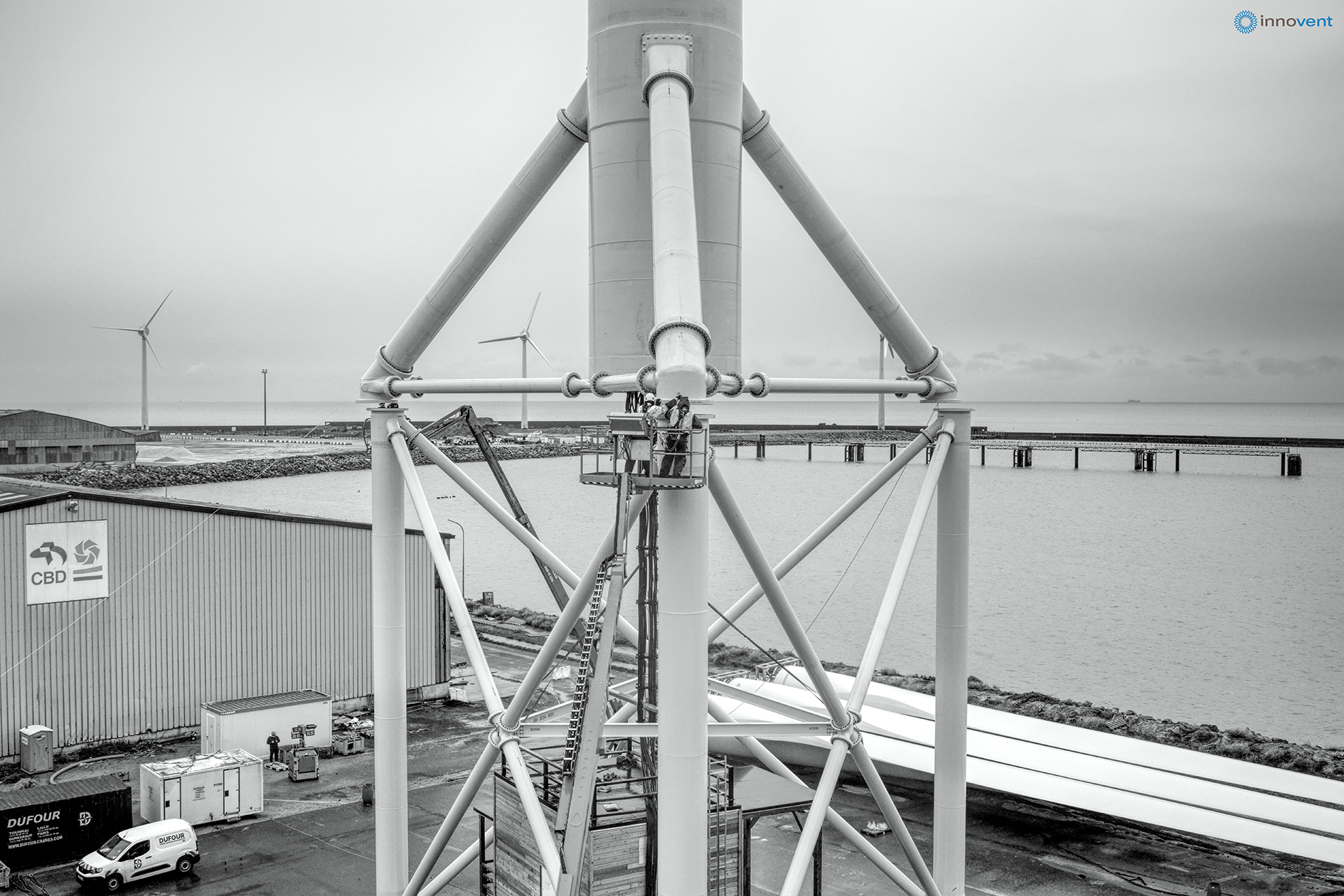
Nabrawind is a Spanish company that invented the Nabrabase. The Nabrabase is a steel tripod structure, which has already been installed three times since the partnership began. InnoVent CEO Grégoire Verhaeghe was convinced of the merits of this invention and decided to take a risk by becoming Nabrawind’s first customer. Today, it is one of InnoVent’s best risk-taking decisions.
Why this foundation?
Firstly, using the Nabrabase allows the wind turbine to be raised. Thanks to this elevation, it can reach significantly higher wind speeds and qualities, increasing production by nearly 40%. In addition, it provides greater environmental benefits, as the amount of concrete required for the foundations is reduced from 500 m³ to 80 m³, and the same applies to steel, which is reduced from 60 tonnes for a conventional wind turbine to 10 tonnes thanks to this solution.
This solution is ideal for rocky ground. We used it to build the tallest wind turbine in Africa, but also to replace the four ageing wind turbines in Le Portel. The tripod wind turbine in Le Portel now produces four times more than the four old turbines that were in place. The InnoVent Diaz wind farm in Namibia is also partially equipped with this solution. Of the 11 machines that make up the farm, four are installed on Nabrabase foundations.
Nabrawind has also created the Nabralift, a system that allows parts to be assembled from below, eliminating the need for multiple cranes. It should also be noted that this system saves considerable time when assembling a wind turbine.
The ingenuity of Liftra, in partnership with InnoVent
The Vänern wind farm in Sweden is InnoVent’s only offshore wind farm. We first acquired half of the farm, i.e. five wind turbines, in 2019, then three additional turbines in 2022, and finally the last two turbines that made up the farm in June 2025. This acquisition followed the bankruptcy of Winwind in 2012.
The gearboxes of these wind turbines had broken, preventing them from functioning properly. This is when the partnership between Liftra, a Danish company, and InnoVent began. Liftra is a company specialising in lifting and transport solutions for the wind industry, and it invented a self-propelled electric crane.
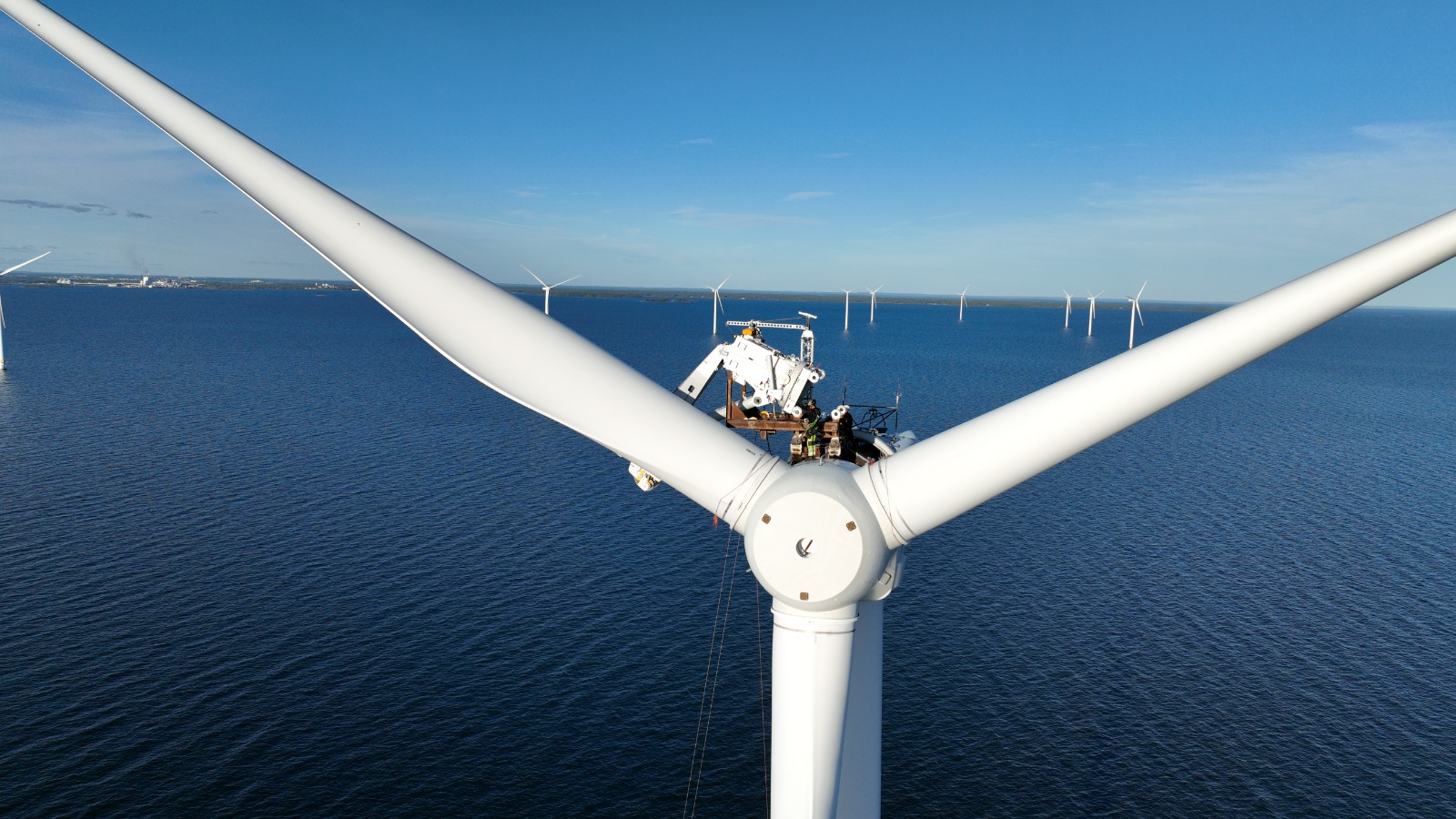
This crane is used to repair wind turbines in offshore wind farms. Maintaining an offshore wind farm can quickly become costly, polluting and complicated, so Liftra’s solution was an obvious choice.
The traditional method of working on an offshore wind turbine requires a 700-tonne crane, around fifteen lorries and a huge barge to stabilise the crane. In this case, the lorries, the crane and the boat towing the barge consume diesel fuel.
The Liftra self-propelled crane means we don’t need to use any other cranes, reducing the number of lorries from 15 to just 2 and allowing us to use a smaller barge. This solution saves us 200 litres of diesel per day.
This crane is hoisted to the top of the wind turbine using cables stretched between the nacelle and the barge. It is electric and recharges its batteries while lowering the parts. In addition, the work can be completed in three days, compared to one week with the conventional system. Smaller barges are also available more quickly: only a three-month wait instead of a year in the case of large barges.
The transponder detector
This transponder detector is one of InnoVent’s brilliant innovations. Critics of wind power often point to the visual pollution caused by the flashing lights on wind turbines, and rightly so.
InnoVent has therefore developed an ingenious system that reduces flashing to just 2% of the time. This detector is a small box installed in the nacelle of each wind turbine. It activates automatic beaconing when an aircraft approaches and deactivates it once it has moved away.
Unfortunately, this solution has been rejected under current French legislation. However, we hope that the law will evolve in our favour so that, like some of our neighbouring countries, we can take action against this visual pollution while ensuring optimal safety for air transport.